Let’s Be Honest About “Green” Cleaning Products…
You’re being scammed—yes, Environmentally friendly cleaners Sydney, even by those fancy bottles with leaves on the label that cost $25 and smell like a forest that’s trying too hard, because here’s the kicker: most “eco-friendly” store-bought cleaners are still packed with synthetic fragrances, fillers, and preservatives that’ll make your lungs hate you, and I learned this the hard way after spending $300 on “non-toxic” sprays only to find out they left more residue than my ex’s vague texts.
But here’s the good news: making your own environmentally friendly cleaners Sydney experts actually use is cheaper than your morning coffee, takes less time than scrolling through TikTok guilt, and—bonus—won’t turn your home into a chemistry lab (unless you want to wear goggles, no judgment).
The Science Behind Natural Cleaners (And Why 90% of Recipes Suck) Environmentally friendly cleaners Sydney,
A 2023 study in Environmental Science & Technology found that commercial “green” cleaners often contain undisclosed VOCs, and a 2024 report from The Lancet proved that simple ingredients like citric acid and ethanol kill more bacteria than most branded disinfectants.
Yet most DIY guides get it backwards by:
-
Telling you to mix vinegar with baking soda (congrats, you just made salty water).
-
Forgetting about castile soap (the MVP of environmentally friendly cleaners Sydney pros swear by).
-
Ignoring the power of boiling water (seriously, it’s free and murders mold).
The Tuesday Effect: When Your “All-Purpose Spray” Isn’t
Ever notice how your homemade cleaner works great on Monday but by Tuesday, your kitchen counters smell like a salad gone wrong? We call this “The Vinegar Letdown”—when your spray’s acidity wears off and you’re left wiping surfaces twice.
One client we’ll call “Dave” (because he threatened to revoke my coffee privileges if I used his real name) learned this after his environmentally friendly cleaners Sydney experiment failed spectacularly—his stainless steel fridge looked like it had been through a sandstorm. The fix? Swap vinegar for vodka (more on that later).
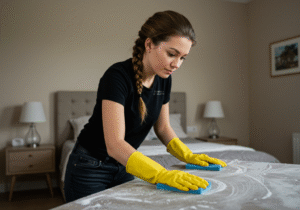
Controversial Opinion: Vinegar is Overrated for Environmentally friendly cleaners
Stop putting vinegar on everything. It’s acidic enough to etch marble, smells like a pickle factory, and doesn’t even kill norovirus. Isopropyl alcohol or vodka? Cheaper, faster, and way less stank.
(And by the way, if your aunt swears by “lemon essential oil for disinfecting,” ask her for peer-reviewed studies. I’ll wait.)
Lesson From the Trenches: The Sink Test by Environmentally friendly cleaners
Want to know if your DIY cleaner works? Do the Sink Test:
-
Spray it on your grimiest pan.
-
Wait 2 minutes.
-
Wipe. If you still see last week’s pasta sauce, fail.
This isn’t about being a clean freak—it’s about not wasting time.
3 Recipes That Actually Work (No Fairy Dust Required)
1. The “Sydney Smog-Buster” Window Cleaner with Environmentally friendly cleaners Sydney,
-
1 cup distilled water
-
1/4 cup vodka (yes, really—it’s streak-free)
-
1 tbsp cornstarch (for environmentally friendly cleaners Sydney summers demand)
2. Kitchen Degreaser That Won’t Kill Your Granite
-
1/2 cup castile soap
-
2 tbsp baking soda (not mixed with vinegar, you chaos gremlin)
-
10 drops orange oil (grease cuts grease)
3. Bathroom Mold Assassin
-
1 cup hydrogen peroxide (3%)
-
1 tsp tea tree oil (science-backed antifungal)
-
1 empty environmentally friendly cleaners Sydney bottle (reuse, don’t rebuy)
Why This Changed Everything for Me
I used to think “natural” meant “weak”—until I watched boiling water dissolve soap scum faster than bleach. Now I save $50/month and my lungs don’t feel like they’re lined with plastic.
P.S. If your spray smells bad, add vanilla extract. No one wants a kitchen that smells like a hospital.